

This month’s tracked data tells a lopsided story. The brands moving up in paid newsletter sponsorships are almost entirely B2B who are consistently buying dedicated placements. Consumer brands aren’t there yet. Where they show up at all, it’s mostly through affiliate links, with just a few one-off paid partnerships — even as fashion, beauty, and lifestyle newsletters rack up hundreds of organic brand mentions and engaged niche audiences. The B2C opportunity on Substack is enormous, and largely uncaptured.
A note: only paid sponsorships are counted here, not affiliate.
↑ Moving up
Antithesis ran four weekly dedicated placements this month, all inside The Pragmatic Engineer, with the same “Brought to you by” slot. They’ve found something that works and are sticking to it. For a developer-tooling brand, there isn’t a tighter audience match on Substack.
Alumni Ventures went the opposite way, with four placements spread across four unrelated newsletters: Upstarts Media, Open Scout, Refactoring, and The Profile. Maximum reach, minimal concentration. One of them (Open Scout) reads as a co-promo “teaming up this week only” rather than a standard buy, which is worth noting.
Small lists, real sponsors
The most interesting signal this month isn’t a big buy, but how far down the subscriber curve paid sponsorships are reaching. A clutch of newsletters well under 15k subscribers landed genuine, disclosed sponsorships, business and consumer alike:
Hummingbirds, a creator-marketing platform, backed No Filter by Kendall Dickieson (~4k subscribers) with the messaging, “this edition of No Filter is brought to you by the amazing team at Hummingbirds.”
Bobbie, the baby-formula brand, is a repeat sponsor of TWO TRUTHS (~7k), a women’s-health and motherhood letter, “today’s letter is brought to you by Bobbie.”
Beyond Nine sponsored The Jones Report (~10k), complete with a reader discount code.
Vestiaire Collective ran a disclosed sponsored feature in Anna Eleri Hart (~11k).
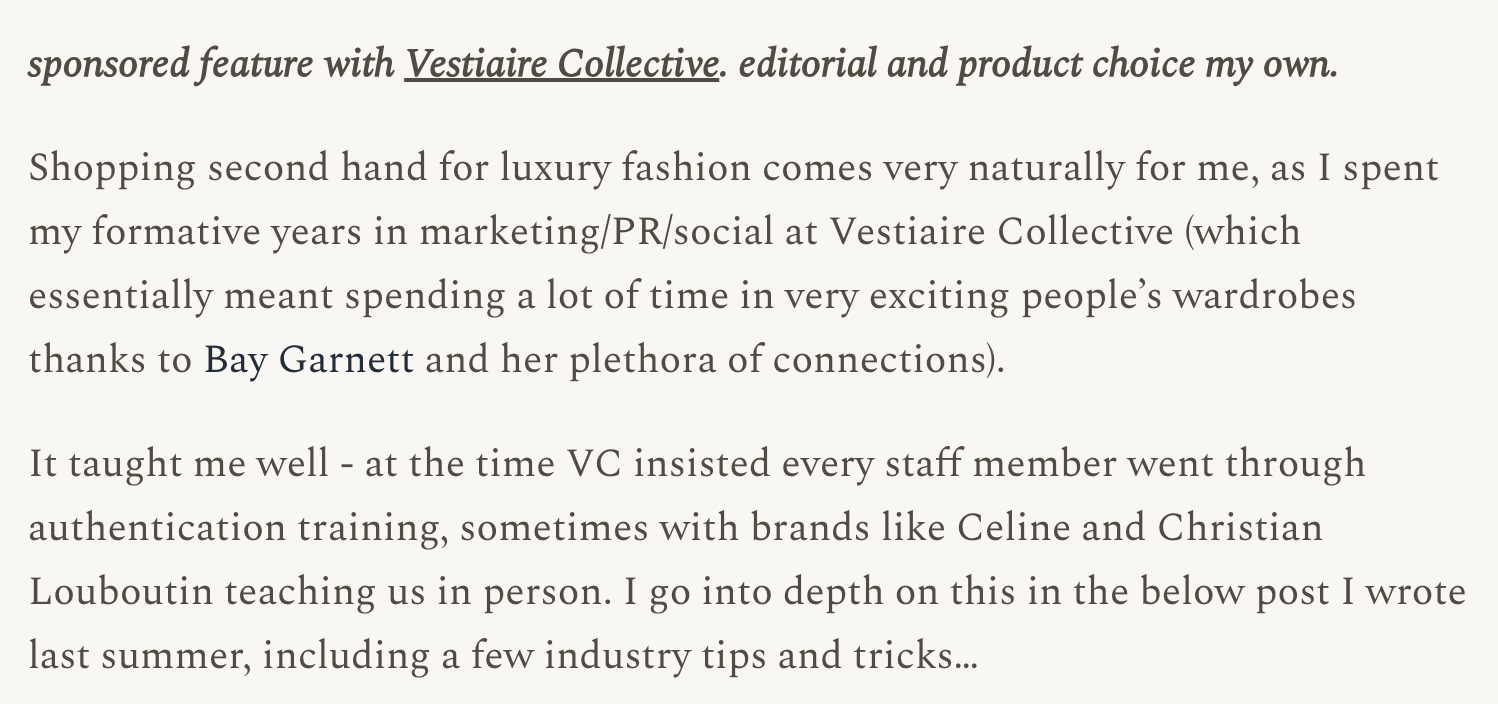
Sponsored post with Vestiaire Collective
The through-line: subscriber count isn’t everything. For the right brand, a smaller audience with a specific, highly-trusting audience beats a larger, general-interest newsletter. A formula brand doesn’t need reach; it needs the right room full of new mothers. Big communities give brands scale. Niche communities give them something harder to buy: relevance.
The same shift is playing out across the broader creator economy. We see nano and micro creators catching the attention of major brands; not despite their smaller audiences, but because of them. A smaller, more engaged community builds the kind of relevance and affinity that compounds over time. Most B2C brands running that playbook on Instagram and TikTok haven't brought it to Substack quite yet.
One exception to this is a brand you’ve seen here before: Sézane, our Vol. 2 spotlight, is still at it, with confirmed paid partnerships across a roster of fashion newsletters this spring, from Scratch Pad to A Family Affair and Pia Baroncini. They’ve clearly found a lane that’s working for them and are doubling down. Curious to see if this eventually leads them to a branded Substack of their own…
↓ Cooling off
Overall brand activity is down. Across the tracked publications, total mentions (paid placements and affiliate links together) fell about 28% month over month, with every category dropping and fashion, tech, beauty, and home leading the decline. Some of that can be attributed to the early-summer slowdown.
The split underneath is the more interesting read: most of that volume is affiliate, not paid. Strip it out and the genuine paid set is smaller and steadier than the headline suggests.
One sharp brand-level signal inside that: SimpleClosure, a service that helps founders wind down their companies, ran five dedicated placements across The VC Corner and Not Boring. A startup-shutdown product buying repeat slots in founder newsletters is telling an interesting story about today’s market mood.
Brand spotlight: BALMUDA
A design brand running a local-network media buy
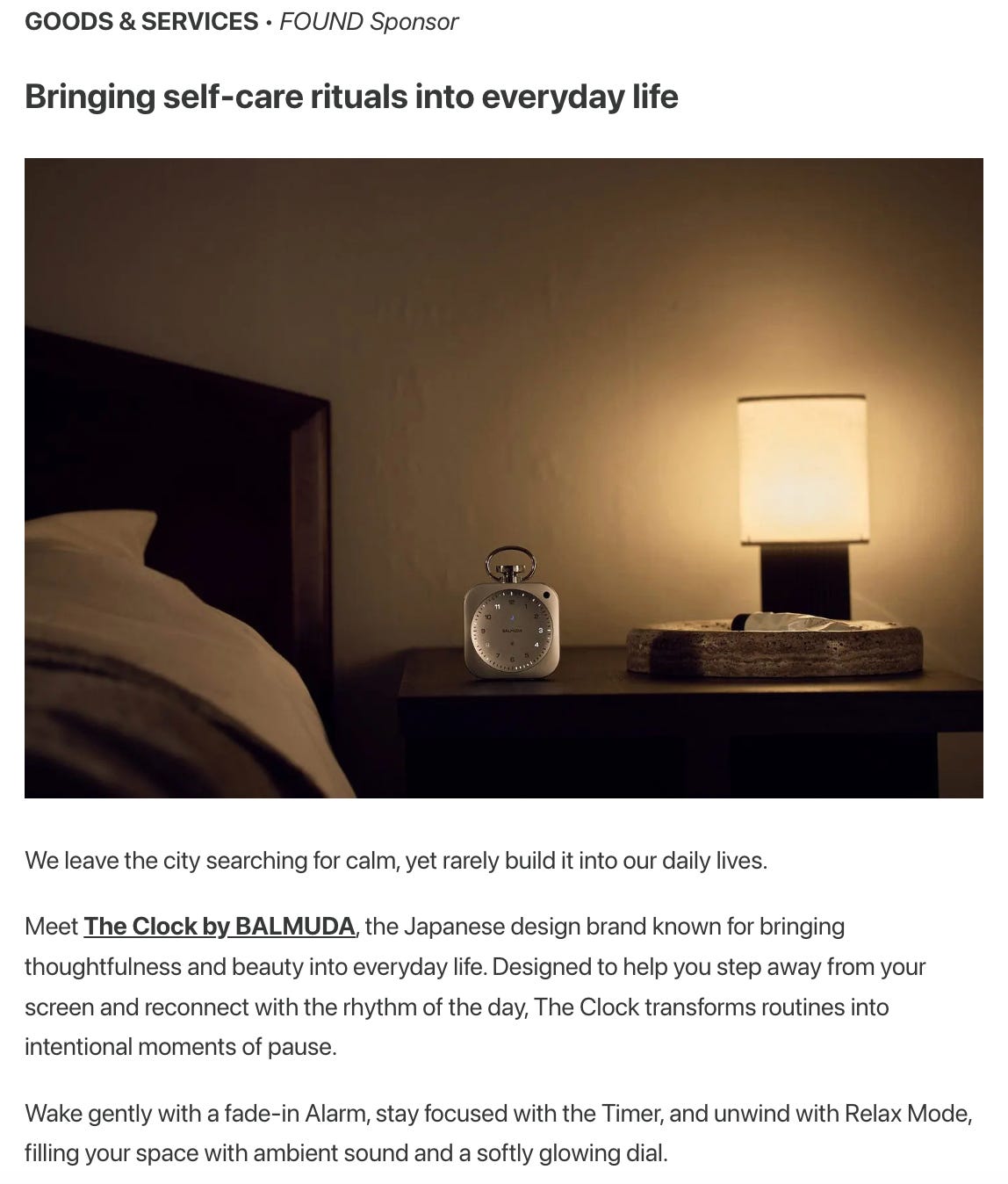
The Japanese design brand placed its product, The Clock, across all three city editions of the FOUND network in a single stretch (SF, LA, and NY) each a dedicated, disclosed [spon] placement with the same creative.
The shape is what’s notable. Most brand activity on Substack still runs writer-by-writer, one relationship at a time. This was the closest thing I’ve seen on Substack to a brand using the platform as a media buy rather than a creator partnership.
Part of why B2B has captured Substack first is that it's often easier to execute with a simpler format: "Brought to you by" at the top, a logo, a link, a landing page. Consumer partnerships are harder: they have to fit the writer's voice, the placement is editorial rather than dropped-in, and inside most consumer brands no single team clearly owns "newsletter partnerships" as it falls between PR, social, brand, and affiliate. The playbook for B2C brand on Substack is still being written and will look different from B2B. The brands that figure out how to buy thoughtfully, not just whether to, will own the channel before it gets crowded.
The watchlist: Petal + Hearth
A 22K creator-business letter, fully unmonetized

Olivia Wickstrom writes Petal + Hearth into a specific niche: women building creative businesses around a slow-living, “design a life you love” ethos, much of it dispatched from the south of France. The letter has hundreds of distinct brand mentions across its archive (Etsy, Duolingo, Sephora, Quince) and not a single paid sponsorship. Every brand she’s endorsed, she’s endorsed for free.
That’s the watchlist’s whole premise in one publication. A specific, high-trust audience already showing up for particular brands (creator-economy tools, lifestyle and home DTC, courses, books, wellness) and not one has converted that affinity into a paid relationship. For a B2C brand in any of those lanes, her audience is already opening your name in her letter for free. The only question is whether you formalize it.
Subs 22K · Organic 215 · Paid 0
The Pulse is a monthly read of the Substack brand layer: who’s running paid placements, what patterns are emerging, and which newsletters brands should be watching. From In House.
So much good info! Thanks Alex 🙏